
Answer services are pretty interesting when it comes to finding a high level definition of “sentiment analysis”. Answer services are sort of a hybrid between algo search and human-run directories with a different user interaction model. You can ask plain English questions and get plain English answers. Answer services touch on what some have called Social Search, pigging backing on social networking trends, although I am still looking for a good definition of Social Search. What I really like is that answers (a.k.a. results) come from people. It’s somewhat along the path of Wikipedia, although the set of info retrieved is made of more diverse answers rather than one by consensus.Answering services do better for sophisticated queries in the form of plain English questions than do 2.1 keywords typed in a traditional search box, even Google’s. More importantly the information retrieved is of a different format. Most volunteering to answer these questions do care (or is it the miles?), include subjective in nature opinions and often provide “tone” clues turning Answers databases into wonderful data sets to mine, extract and make sense of “sentiments”. Yahoo! has pushed theirs very aggressively, Microsoft Live’s QnA was introduced in beta recently. Google recently discontinued theirs. Cannot ask about “sentiment analysis” to Ask although answering plain English questions was really Ask’spop’ing up: Wondir, Yedda, LinkedIn.
vision in 1995 … just too early to work, maybe. More are now Overall, LinkedIn did best, by a long shot. Makes sense, my network is made up of people that i) care about Sentiment Analysis … if anybody does, and ii) care about me … say, just a tinny biot more than a total stranger. Answers are as good as the people you ask the questions from, right? Well, LinkedIn is all about people you know and just released an Answer service with a really nice, intuitive, minimalist and simple Answers results page. Right on, don’t overdo it. I particularly like to see the names of the contributors in bubbles on the left of the comments.
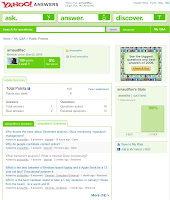 Hitwise‘ LeeAnn Prescott reports in an interesting article by Jason Lee Miller that Yahoo!’s got all the answers, well, 96% of them anyways. Y! pushed Answers pretty hard with commercials and more over the past months. I asked Yahoo! Answers what was sentiment analysis, buzz monitoring about 2 weeks ago. the question is now closed. I got 1 answer, not a very good one but thank you anyways. That question closed since. I asked again who knows the most about sentiment analysis, buzz monitoring, reputation management about 16 hours ago and I have not received an answer yet. I have had good experiences before for other questions, though. It really comes down to reaching the masses and creating that Network effect. eBay succeeded, I don’t think there will be many Q&A services at the end of the day, or vertical niche ones.
 Microsoft Live QnA just shipped in beta recently I believe. It will take them a while to ramp up to reach critical masses of questions, answers, and users for both. Microsoft’s got decades of linguistic R&D, though, and could very well catch up by providing better more relevant answers. I asked again what was sentiment analysis and Internet buzz monitoring? I got one spam answer. I still remember to this day an internal R&D presentation about speech-to-text in 1996 when I was doing product planning for Microsoft Works in the Office division. One of the main researcher was talking about how they got 98% there, but the remaining 2% made it still impossible to use in everyday applications. It certainly still feels that way when I have to call American Airlines’ automated system to change a flight. It drives me crazy! Then you could say, maybe the French accent’s got something to do with that, right? Anyways, I asked Live QnA again about 16 hours ago, and got 3 spam answers. Yahoo!’s doing a better job at filtering spam.
 Yedda was not bad, got a couple answers, including one describing IBM’s definition of sentiment analysis. The UI is a bit over monetized, but hey, none of them are philanthropic organizations, right?
Amazon’s Askville just launched. Frankly, I am scared of Amazon knowing everything about what I read and the questions cycling in my brain … could turn into some privacy fears. That’s true of anybody online actually. Diversify! This said within a couple hours of asking the same question, newbie203175 a very good answer for the 3 terms:
- “Sentiment analysis involves classifying text based on its sentiment. Sentiment analysis seeks to identify the viewpoint(s) underlying a text span; an example application is classifying a movie review as “thumbs up” or “thumbs down”. […]
- The best buzz-monitoring is a tracking tool a web-developer might be willing to use foranalyzing and monitoring his/her recent web-projects. In order to analyze the popularity of a page regularly, you have to have some statistical data and values […]
- Reputation management is the process of tracking an entity’s actions and other entities’ opinions about those actions; reporting on those actions and opinions; and reacting to that report creating a feedback loop. All entities involved are generally people, but that need not always […]”
And finally, I also tried Cha Cha search, interesting model where human beings actually do the searching for you and return the results as is. The answers weren’t bad but I still have to do all the work of extracting the info myself.
Share this article
Latest Insights


mAI Intelligence Briefing
Practical insights on AI marketing systems, decision intelligence, governance and the evolution of the mAI Framework.
Categories
Explore mAI
See how the AI Marketing OS, AI Marketing Brain and Human Command connect strategy, execution, measurement and governance.
